Friday, May 21, 2010

Another brief interruption about to end...

I was away from blogging for almost two weeks; first because of the never-ending moving and then due to a never-ending cold.

I feel better now, at least enough to clean the several hundred emails that have amassed over the course of the last few days, and as soon as I am done with that, I will return to blogging. First step will be archiving my Hurriyet columns. I should be in full blogging mode by Monday, but until then, I am in construction mode:

Upps, that's the wrong sign, but who cares:)....

Monday, May 17, 2010

Weekly Hurriyet Column: Fiscal Rule: Dead the day it was born

Below is the unedited version of my column for this week. You can read the final version at the Daily News website, but since I have been editing my columns myself on the Daily News website since March, you won't see much of a difference between the two. As for cheesy references, I am sticking to movies again, but it is not a classic this time around (see the text for the hyperlink).

As for the column, Yapi Kredi Research came up with the most original piece on the fiscal rule, coming up with a more efficient formula. Although they have a web site, I could not find the paper there. I will ask them to put it on the web, and if they agree, I will link to it as an addendum to the column.

BTW, loyal readers would know that the fiscal rule has got my attention since it first surfaced back in September. A blog post summarizes my views on the topic as well as providing links to all my articles/posts on it. More recently, I responded to a reader request, and was spectacularly proven wrong, claiming that given the political agenda, it'd be tough for the government to get the fiscal rule on the table by the end of June. Uppssss.......

Anyway, on to the column :


I was watching a Richard Gere movie last week, where one of the villains had a tattoo on his forehead in Cyrillic that read “I was dead the day I was born.”

The expression seemed to ring some bells. First, I thought it was from a Beckett play, but I had given up on existentialism long ago. It all made sense a couple of days later when Economics tsar Ali Babacan unveiled the much-awaited fiscal rule, establishing that I had experienced some kind of premonition.

As Cornelius Tacitus once noted, viewed from a distance, everything is beautiful, and the Fiscal Rule is no exception. I was pleasantly surprised to learn that the rule will cover the general government, which includes social security institutions, local governments and extra-budgetary funds. The actual formula looks very appealing to the eye as well, especially after Babacan’s comments that the tightest formula had been chosen and that the adjustment coefficients ensured a three-year convergence period. Most of my esteemed colleagues rushed to hail the formula as too rigid.

I would argue that the growth side of the formula, with 5 percent penciled in as the long-term growth rate, is not cautious enough. You could counter me by pointing at Turkish growth performance after the 2001 crisis, which was, by the way, supported by extremely loose global financial conditions and arguably the best world growth spurt in history. A simple Excel exercise reveals that even with a respectable growth rate of 4-5 percent over the next few years, debt declines very slowly.

As for the three-year convergence, the coefficient of one-third means that the deficit will simply be reduced by one-third of the gap between current and targeted deficit, not that the target of 1 percent will be reached in three years. Plugging in my 2010 deficit-to-GDP and growth projections of 4.5 and 6 percent to the same Excel sheet and fixing growth at the neutral rate of 5 percent thereafter, I find that it takes almost a decade to reach the deficit target. I doubt such a modest trajectory is the right path for a country that suffers from CSD, or chronic savings deficiency.

But my biggest objections are on the rule’s implementation. A useful analogy could be made with inflation targeting: Having inflation targeting or even attaining the targets does not make a central bank credible; it is the institutions that come along that do. Similarly, without an independent and authoritative budget monitor or fiscal council, the fiscal rule is not likely to gain much ground. The Court of Accounts, the designated auditor, simply doesn’t have the know-how, political independence or sanctions power.

Similarly, without having been hammered into the Constitution, there will always be the risk that the rule will share the destiny of the ill-fated borrowing limits in the fiscal control law of 2003, being cropped or even nullified with subsequent laws. I find it extremely suspicious that in some places, the rule just looks like a repackaging of that law, which makes me wonder, “If it didn’t work last time, how come it’ll work this time?”

Last but not the least, experts have pointed at lack of full transparency and shenanigans in the general government accounts, which do not bode well for the implementation of a fiscal rule, where reporting will be done by the Ministry of Finance. Combine this with an in-house audit, and you have the recipe for disaster.

Despite last week’s display of prophecy, I am not sure whether I have sixth sense or not. I am definitely not seeing any dead people, but I think I may have just seen a dead fiscal rule.

I also know that with all the over-jubilation, I’ll probably suffer the fate of Cassandra, at least in the short-run.

Emre Deliveli is a freelance consultant and columnist for Hurriyet Daily News & Economic Review and Forbes as well as a contributor to Roubini Global Economics. Read his economics blog at http://emredeliveli.blogspot.com.

Monday, May 10, 2010

Weekly Hurriyet Column: Hot money blows emerging markets balloon

Below is the unedited version of my column for this week. You can read the final version at the Daily News website, but since I have been editing my columns myself on the Daily News website since March, you won't see much of a difference between the two. As for cheesy references, I couldn't get any this time around:(


Everyone has got her own take on what caused last week’s wild ride.

For some, it was fears of euro area sovereign risk contagion. For others, it was China’s tighter monetary policy. Yet others tied the sharp falls to intraday selling by electronic trading systems.

I am more interested in consequences, but at first glance, this seems like an almost trivial exercise. In periods of contagion, investors become risk-averse and flock to safe-haven assets such as gold and U.S. Treasuries.

With the yield on 10-year bonds hitting below 3.3 percent, the lowest level since late last year, and gold surging above $1,200 an ounce amid Thursday’s turmoil, last week proved to be no exception. Then, it was no surprise that emerging market currencies suffered, but it was the different levels of misery that was most intriguing.

If you really try, you could tie the pressures on the Hungarian forint, the Polish zloty and the Czech koruna to fundamentals: In all three countries, policy-makers had recently voiced worries on the over-appreciation of their currencies and were willing to keep rates lower for longer- considerably more dovish, in other words, than the Central Bank of Turkey. There is also political uncertainty in the Czech Republic and Poland, with elections looming, and policy uncertainty in Hungary, as the new government intends to loosen fiscal policy.

But none of these changes the fact that Poland’s economy is essentially healthy. Neither can fundamentals explain the fact that these three currencies underperformed even relative to the beleaguered euro. Things get even trickier once you adopt a more global perspective. Other underperformers of last week were the Mexican peso, the Brazilian real, the Indonesian rupiah and the Korean won. Don’t waste your time trying to find similarities between these economies; I already did, to no avail - or at least until I looked into portfolio flows and discovered an almost perfect negative correlation with currency depreciation.

Countries that have received the most portfolio inflows in the last year seem to have experienced the largest selloffs last week. Poland, having received over $25 billion over the past year, is a case-in-point. Turkey, with less than $5 billion of inflows, is the other side of the coin. In the latter’s case, foreigners had actually significantly reduced their positions during the political crisis of 2008 and the Lehman collapse, but then never really got back in. With foreign presence so light, it was no surprise that lira tremors were less than peers.

This is not to say that fundamentals did not work in Turkey’s favor: The Central Bank’s relatively more hawkish stance compared to its peers, the large foreign currency resident deposits, the positive recovery outlook, and the country’s less ugly stature in the investors’ beauty contest I discussed a couple of weeks ago all helped to keep the lira relatively stable. But I would argue that they were merely talented supporting actors in a drama crowned by hot money.

Before you congratulate me for having written something useful for a change and go long-lira, note that other fundamentals such as external financing or the fair value of the lira do not justify more real appreciation no matter how hard you try. In other words, Economics is definitely not as lira-supportive as most analysts are fervently arguing.

But irrespective of your feelings for the lira, last week has provided, if anything, lots of lessons for students of finance as well as tremendous buying opportunities in the international currency arena.

Just remember that as John Maynard Keynes noted, markets can remain irrational a lot longer than you and I can remain solvent.

Emre Deliveli is a freelance consultant and columnist for Hurriyet Daily News & Economic Review and Forbes as well as a contributor to Roubini Global Economics. Read his economics blog at http://emredeliveli.blogspot.com.

Saturday, May 8, 2010

Yet more on the fiscal rule

Reader "age" wrote the following comment on an end-March post on the fiscal rule:
Dear Sir, I am firmly convinced that a fiscal rule can be a very effective tool for fiscal discipline. As you mention in your note, the institutional setup is key to its success. Switzerland had a constitutional (!) borrowing constrained that was never applied. A better designed new fiscal rule changed everything, however. What changed was a binding annual ceiling for (cyclically adjusted) spending (based on cyclically adjusted revenue). There was not the possibility anymore of temporising. The rule also has a defined sanction mechanism which quickly enforces sanctions if deviations occur. A Swiss type rule (with some modifications) might be successful in Turkey too.
I honestly did not know anything about Switzerland's fiscal rule, but I had a quick look at it this morning. And as the reader notes, a rule based on spending, rather than the government deficit, could have worked better for Turkey, as I have argued before.

BTW, at the press conference for the Inflation Report a couple of weeks ago, CBT President Durmus Yilmaz noted that he expected the government's new fiscal rule to be agreed by the end of June 2010, and this timetable seems to be consistent with the Treasury's timetable. With fiscal worries high on the investors' agenda, even an ill-designed fiscal rule would be a boost, at least in the short-term, to Turkish assets. But I am not sure if the government will be able to deliver, especially since we are in May and the government is a political mess that will go all the way to a Referendum and Constitutional Court (if CHP keeps its promise to battle the AKP on all grounds).

EconNews Roundup

Lira as safe haven according to some analysts: Well well well... When the lira depreciated 5% in a couple of days, this piece sounds kinda funny, but don't forget that lira has performed better than peers in CEE since the beginning of the year. And there are are some compelling reasons for the lira to be a safe haven, or at least not be hurt as much as most of its peers. Actually, the article would have been more informative if it spent more time explaining those reasons, some of which are mentioned at the end. But before you go long-lira, note that fundamentals such as external financing or the fair value if the lira do not justify more real appreciation no matter how hard you try. Also remember that a lot of analysts are simply (and implicitly) assuming mean reversion when they are bullish on the lira: Since lira has underperformed in the recovery, it will perform better from now on. While the events of the last few days have justified them so far, lira's unique characteristics, such as huge FX deposit base, may mean that the Turkish currency has simply less volatile than its peers- keep in mind that I am just thinking aloud, it is way too late to look at Sharpe ratios or implied volatility without a Bloomberg terminal.

Notes from the IPO Turkey Summit: I think it'd be a good idea to discuss why IPOs are so low in Turkey (hint: demand and supply factors both play role). And if you want to get confused on the eternal chicken-or-the-egg dilemma, see here.

A better way to create jobs (than force firms to hire workers, a la RTE)

The foreign interest in malls seems to have died down, but the sector is yet recovering.

Friday, May 7, 2010

Good Morning in Uskudar:)

Foreign media, after having been impervious to Turkey's political risks for eternity, seem to have finally woken up.

Perhaps even more interestingly, the single-minded reporting of the prosecutor's prosecution as a step towards democracy is being questioned by a well-written WSJ article.

As I have been extremely critical of foreign media's coverage of Turkey in the past, I bow down and congratulate Reuters and WSJ- and hope that my favorite daily will soon follow suit rather than publish pieces reeking of advertising (more on that later).

BTW, HT to Atilla Yesilada for both articles; I am not an avid follower of Reuters or WSJ were it not for him... BTW, he has a summary of the Reuters article in Turkish.

Thursday, May 6, 2010

Commercial Break

Loyal readers would know that I do advertising rarely, and only when it's worth it. The upcoming training seminar from Deloitte Academy, Understanding and Interpreting Economic Variables, would definitely fit this category. And as an added bonus, it will be run by one of the few people who your friendly neighborhood economist would easily label as having a much better grasp of Turkish economic data than himself...

The only downside is that the training will be in Turkish, I presume...

EconNews Roundup

US investment in Turlkey may recover next year: I am just linking this to remind everyone of ABFT's excellent report on the Turkish reform agenda.

Speaking of reform, urge on reforms from ex IMF rep: The points he raises, such as labor reform, are very similar to mine when I decided to tackle Turkey's stagnating reform agenda, first for the Daily News, then for Risk Advisory Group. As I have repeated many times, Turkey's priority reform agenda is well-known; the problem is finding someone to implement it.

Greece's defense spending: So are they saying that, like the end of the Cold War, did Turkey have Greece spend their way into bankruptcy?:):):)

IPOs on the horizon: Note that there is an argument that these IPOs could be hit by the political tensions. While I don't subscribe to that argument in full, contrary to what some claim, politics has been a driving force on Turkish assets in the last couple of years, but only when tension has risen significantly. Moreover, the international climate has increased the chances of a road accident.

Moody's downgrades Finansbank: The importance of being Greek...

Wednesday, May 5, 2010

A very late addendum...

... to last week's Hurriyet column: In case you are wondering, the title was a reference to one of the popular songs of the early 80s. I was watching Music & Lyrics when I realized that my young readers may not be as verse in the early 80s, 1983 to be specific, when this song was a big hit and the eziks won the FA Cup for the last time.

I am stuck at home with a really bad cold, so you should see quite a few posts from me in the next couple of days. BTW, a couple of friends are sick as well, so I am wondering if there is another flu epidemic in Istanbul- weird for this time of the year...

Tuesday, May 4, 2010

EconNews Roundup

Bureaucracy lacks equal gender representation: Fair point, but I wish that were the only problem of women's labor.

Dervis tells Turkey to increase savings for sustainable growth: I wish he also told how to do that.

For the lack of a better word, the weekly column of my time-sharer in Hurriyet Daily News & Economic Review: I agree with all he is saying, and I was going to link you to the paper I wrote with Adres Velasco on the Fund, but I couldn't find it on the net, so you'll just have to email me if you are interested.

Addendum to this week's Hurriyet column

Tarik left a comment to a previous post, where I was forming the ideas of yesterday's Hurriyet column:
why do you think the cbt is swerwing off the road?because cbt is not sticking to its policies to reduce the inflation?if so why is not doing so? the economy is on its way to recover,so i guess the inflation should be increasing a little bit,what is expected to cbt is to bring the inflation under control if it gets out of control? can you explain why the credibility of cbt is questioned?
Tarik wrote this comment before he was able to read my column, so he should be OK with the swerving off the road, but it just means that the CBT will give in before markets in the chicken game. But in the latest Cnbc-e survey of policy rate expectations, now more economists and Treasury officials are expecting the first hikes in September and October, so first round to the CBT...

As for what would be expected for the Central Bank, raising rates would be one... There is also another argument for rate hikes, which I did not have enough space to explain in the Hurriyet column: All the Central Banks around the world, especially Turkey's peers, are either raising rates or getting ready to do so. One could example is Brazil, where the rate difference between the two countries, especially in real terms, is starting to get a bit too conspicuous. I wonder if this could start affecting portfolio flows and have negative consequences for the lira, but the Central Bank obviously does not think so.

As for Tarik's last question, the credibility gap is the difference between market's and CBT's inflation expectations. As the Bank just revised its year-end target to 8.4% from 6.9% and with year-end expectations at 8.2% (see graph below), there is no credibility gap on that front. But 12 and 12-month ahead expectations are still hovering around 7%, significantly above the Bank's targets for 2011 and 2012, presented below by Turkey Data Monitor:

By the way, Statistics continue to support the view that we may be seeing more of a base effect, with yesterday's consumer confidence and PMI releases being cases in point. The former brings home Mary's point on perceptions driving reality, which I really should look into one of these days...

Monday, May 3, 2010

Weekly Hurriyet Column: Rebel with a cause

Below is the unedited version of my column for this week. You can read the final version at the Daily News website, but since I have been editing my columns myself on the Daily News website since March, you won't see much of a difference between the two. As for cheesy references, I am sticking to movies with an oldie but goldie. All the other references are embedded as hyperlinks in the text, as I have started doing since I got the web-editing power of my columns, but I forgot the read my lips reference at the very end- the hyperlink has even an actual recording. By the way, the column it is a continuation of a Thursday post, so the credit column got dumped yet again:( The perils of writing once a week...

As for the column, an important point I had to leave out because of space constraints was the analysis of when the CBT should raise rates. Using a Taylor rule, I tried to justify the 4Q rate hikes with all the different parameters, and I couldn't, even with quite high output gaps. In most cases, I found that the Bank should have already started tightening in the last couple of months. But, this exercise is kind of pointless because as I explain in the column, the CBT sees inflation as temporary, so its actual inflation is not the inflation we are seeing. Of course, another explanation would be that the Bank has a third factor in its interest-setting equation, such as elections or the smile on the PM's face. Now, we are getting into dangerous territory:)...

Anyway, on to the column and by the way, apologies to Korean readers for my little pun, but it wasn't me who invented "come to Seoul to shake up your soul" or "Seoul, the soul of Asia"...


I always felt bad for being the sole soul outside Seoul confused by the Central Bank of Turkey, or CBT.

But for once, I feel comfort in the company of strangers: With more or less equally divided between labeling the Bank’s latest Inflation Report as hawkish or dovish, economists seem to be as baffled.

In fact, the Report has elements of both: While the Bank’s upwards revision of its year-end inflation forecast to 8.4 percent from 6.9 percent and its discussion of risks to its baseline inflation and policy outlook are definitely on the hawkish side of things, its commitment to hold rates until the last quarter and engage in limited hikes thereafter are definitely signs of dovishness.

The Bank has also been kind enough to share with us what led to the upward revision in this year’s inflation forecast: Higher energy and food prices (0.15 and 0.55 percent), larger-than-expected impact from the January tax measures and a narrower output gap (both 0.4 percent).

The latter reveals that a fast recovery is not in the Bank’s baseline scenario. And I would have concurred, were it not for recent data: April capacity utilization and real sector confidence, both from the CBT's monthly business tendency survey, came in quite strong last Monday. Although these figures have lifted the hopes of even a perennial pessimist like me, one month’s data is hardly enough to reach a firm conclusion.

But my work with Konda for their Barometer surveys, which I am not allowed to disclose, has led me to question one of the Central Bank’s key assumptions that, with unemployment expected to remain high, the recovery is not expected to be inflationary.

The contributions also build the case that the rise in inflation is due to temporary factors and therefore temporary. That’s how the Bank can justify its dovish policy rate stance and low inflation forecasts for the next two years: 5.4 and 5 percent for end-2011 and 2012 respectively, conveniently just below the Bank’s targets for both years.

Again, I am puzzled: With the output gap bound to close in that timeframe, the lira unlikely to appreciate in real terms significantly much more and barring any positive surprises on the supply-side, I cannot see how inflation will suddenly fall 3 percent next year rather than get stuck in the 7-8 percent range.

On the other hand, I am crystal clear on the Bank’s stance: With inflation expectations still untamed, the Bank has been forced to play the James Dean chicken game with the markets. As any student of Economics would know, that game has two pure strategy Nash equilibria, one which the markets cave in, and one which the CBT yields.

There is a also a mixed equilibrium, but it is way too early on Sunday, and without my morning cup of coffee, I am likely to get mixed up. As I am too lazy to open my favorite game theory book, you should consult the nearest theorist, but if you just are wondering the opinion of your friendly neighborhood economist, I am getting slightly more inclined towards the Bank swerving from the road.

As for the Bank’s attention to factors that could lead to earlier rate hikes, such as the rise in inflation expectations leading to deteriorating price-setting behavior, sharper-than-expected pick-up in global demand or commodity prices and loose fiscal policy, the CBT is simply executing deterrence theory, an artifact of the Cold War. Deterrence theory might have worked, but we could have easily ended up in the Dr. Strangelove world as well.

Turning to more recent history, my friends at Global Source titled their take on the Inflation Report “Read my lips: No Hikes until the fourth quarter”. I don’t know if it’s just me, but I suddenly remembered Papa-Bush talking about tax hikes.

Emre Deliveli is a freelance consultant and columnist for Hurriyet Daily News & Economic Review and Forbes as well as a contributor to Roubini Global Economics. Read his economics blog at http://emredeliveli.blogspot.com.

EconNews Roundup

Inflation at 17-month high: Despite the headline, the figure was lower-than-expected. But that's no reason to rejoice, for two reasons. First, core inflation is on the rise. Second, there was a sharp fall in communication, which is, according to TURKSTAT (as reported from Global Source, who asked them about it) is a methodological adjustment.

More energy investment in Turkey....

...And we get a new energy index.

Turkey ranks 16th in PPP-adjusted GDP: I said 17th when I was quarreling with my uncle, who firmly believes Turkey is a agricultural society, so thanks to Zaman for the update.

Exports continue to bounce back strongly, according to preliminary figures from TEA.

Yet another confidence index on the rise.

Friday, April 30, 2010

More on the Beauty Contest Story

Loyal reader (and occasional brainstorming partner) Mary Stokes of Roubini Global Economics had more to add on the beauty contest theme of this week, which first appeared in a post last weekend and then featured in my weekly Hurriyet column as well as a couple of addenda to the column. The last addendum, by the way, will form the pillar of my Hurriyet column for next week, which will be on the Bank's latest Inflation Report.

Anyway, coming back to Mary's points, first she agrees with my beauty contest idea:
I really liked a number of the points you made in your most recent beauty contest blog post. I completely agree that Turkey's hailed performance of late is the result of the economy being the 'least ugly' compared to its peers. And a related issue that I'm struggling with is that perception can drive reality. Turkey, along with Poland, are arguably the 'least ugly' in the emerging Europe universe and both are seeing a pick-up in capital inflows.
She then goes on to note that the figures do not support a fast recovery for now:
I agree with you that what we are seeing in Turkey thus far does not signal a robust recovery. Much of the strong y/y numbers we're seeing (eg. IP) have to do with the severity of last year's downturn and I can't wait to see the hullabaloo that results when the Q1 print comes in.
As I noted in a Roubini Global Economics post, I held the view that fast recovery was a myth, along with stable politics and loose financial conditions, until last week's public capacity utilization & real sector confidence data, as well as for-my-eyes-only Konda unemployment figures, all for April. In terms of probabilities, I would have gone for the slow recovery scenario 85% a week ago. After Monday's releases, I was down to 70%, and after working with the Konda survey, I am at 51%, a la Nostrada-Mustafa. Anyway, without digressing too much, let's come to Mary's key point/question:
But my question is: could the appearance of strong growth actually help stronger growth come about, at least in the near-term?
I would think, yes... Maybe, that's what's going on with the latest real sector and consumer confidence numbers... Measuring the direction of causality would be a great exercise, which I plan to do in my spare time. For example, one interesting exercise would be to measure how much the relevant subindices of consumer and real sector confidence turn into actual figures (consumption, investment, etc) in the timeframe specified in the surveys...

Mary goes on to make another important point:
In Turkey's case, it looks like portfolio investment has turned positive since November 2009. I wonder how much of that is money looking for a safe place to park and I wonder what will happen to such flows (and how quickly they could reverse) if Greece turns into the next Lehman moment the way some are now suggesting.
The Greece situation turned even sourer after Mary wrote this email several days ago, but EM flows continued to be as robust as ever, according to latest EPFR data, at least. So we'll see....

On Competition (II)- Doing Business in Turkey: A Tale of Two Crises

As you might (or might not) know, I sometimes get commissions for writing, anything from op-eds to academic stuff. I recently wrote a short piece for the Risk Advisory Group for their monthly newsletter on doing business in Turkey. Below is the text, so that my loyal readers can enjoy it and other can accuse me of scaring foreign investors away. It is kind of a continuation of the Hurriyet Daily News piece I wrote back at the end of February.


Economic historians will probably conclude a few decades from now that two crises in the first years of the new millennium had a profound impact on the structure of the Turkish economy.

The 2001 domestic crisis paved the way to the macro reforms of the next five years. Commendable execution of a well-planned IMF program, with an expansionary fiscal contraction and banking reform at its pillars, did wonders for the economy in the ruling Justice and Development Party’s first term in office, leading it to nearly 50 percent of the votes at the 2007 general elections.

It is therefore not very surprising that despite some recent slippage, especially on the fiscal front, the macroeconomics environment came out at the top on American Business Forum in Turkey’s latest annual survey on Business and Investment Climate in Turkey, which was released at the end of February.

The 2008 global crisis, on the other hand, stalled the government’s infant attempts at micro reforms, as Economics Minister Ali Babacan candidly admitted at the IMF-World Bank Annual Meetings in Istanbul back in October. As some countries capitalized on the crisis for pushing forward their reform agenda, Turkey’s World Bank Doing Business ranking fell to 73 from 63 a year earlier.

But the overall rank could be misleading. For example, as a result of the government’s early reform drive, it takes 6 days to start a business, down from 38 in 2004. Other areas of relative strength are registering property, enforcing contracts and protecting investors. On the other hand, closing a business, dealing with construction permits and employing workers are areas where Turkey literally ranks at rock-bottom.

Whereas the Doing Business survey, which depends on objective criteria such as the number, time and cost of procedures, is useful for benchmarking, actual practice can be quite different from what is written on paper. Therefore, it is useful to supplement such surveys with the private sector’s subjective opinions, and by asking 110 U.S. company executives their perceptions on the Turkish business and investment environment, the American Business Forum survey does exactly that.

According to these American executives based in Turkey, the main areas in need of improvement are university-business partnerships, policy transparency, customs, legal system and corruption. Incidentally, these are the same problem areas that came out in the 2007 inaugural survey, confirming that there has not been much reform in the past couple of years. Moreover, the results are strikingly similar to the wider-sample 2006 World Bank Investment Climate Assessment survey, attesting to their robustness.

It is also important to be aware of regional disparities. For example, U.S. executives are satisfied with their employees who have degrees from top Turkish universities and American graduate schools. But as a recent World Bank study on higher education highlights, this rosy picture darkens quickly once you begin talking to small and medium-sized enterprises in the hinterland, who often complain of not being able to find skilled workers even at significant wage premiums.

Perhaps most worryingly, the government has stopped to listen, as a top-level executive of a multinational firm based in Istanbul recently confided: “I am unaware of any sector that has established a sustained, constructive and forward-looking dialogue with the government on coherent policies and strategies”, she noted.

This is really bad news for a government whose receptiveness to the private sector was one of its defining strengths early on.

My own 15. min. of fame (Part II)

I had mentioned some time ago my induction to the billion-club, Andy Warhol's 15 min. of hall-of-famers. The short interview went OK, and a friend managed to record it for me. I finally managed to get a copy of it, and I am presenting it for your viewing pleasure below. Unfortunately, the interview is in Turkish:


Note that a more complete view of this interview was outlined in two Hurriyet columns, one before the CBT's exit strategy and another after.

Reader Request: Of Politics and IPOs

A reader, who is working for an M&A tracker company, recently asked me the following question:
Can you give me a quote for a piece I'm writing? I need your thoughts on all the upcoming IPOs happening potentially in the middle of a referendum season.
Honestly, I had not given the issue much thought, as I am not into equities, although I knew that there are quite a bit of IPOs coming. But now that I think about it, I don't see this as a big problem at all. My optimism will come as a surprise to my loyal readers who know me as the perennial pessimist, but the major force driving equities in Turkey is foreigners, as the graph below clearly illustrates:

With emerging market flows strong, EEMEA getting a good chunk of the recent flows and within EEMEA Turkey seen as a star performer, as I mentioned in my last Hurriyet column, the mood is definitely Turkey-positive. And as a political analyst whose opinion I value a lot recently noted in a research note, foreigners have yet to grasp that the referendum is a winner-take-all battle for AKP and anti-AKP (CHP-MHP, secular establishment, etc...) And as long as EM->EEMEA->Turkey sentiment continue to stay positive, those IPOs may be over accident-free.

I don't want to misrepresent my thoughts: I do think that sooner or later foreign investors will catch up to the political reality as well. But I do think that it will be later rather than sooner and only after a major event that will be the breaking point of all the pressures building up. But until then, enjoy the ride...

Reader Request: Books on the Turkish Economy

A reader recently asked me on recommendations for books (English or Turkish) on the Turkish economy, which I am more than happy to oblige. Before I present my list below, there are a couple of disclaimers: First, I am only writing about books I have read and am familiar with, so this is in no way a complete list. If you do a book search on Amazon, you can find quite a few titles, ranging from Banking to Customs Union, on the Turkish economy. Second, I wanted to list general books rather than specific titles, so a book on Banking would not be on the list below.

So, here we go:

Ekonomi Politikası / Teori ve TĂĽrkiye Uygulaması (Political Economy, Theory and Application to Turkey) by Mahfi Egilmez and Ercan Kumcu: The authors are two well-respected policy economists (with credible academic hats as well), Kumcu was a long-time vice president in the Central Bank of Turkey and Egilmez the undersecretary of the Treasury. What I really like about the book is that it combines macro theory with applications to the post-liberalization (since the mid-80s) Turkish economy. Of course, it does not claim to be a comprehensive expose of macro theory or recent Turkish economic history. But after going through the book, you’ll definitely have a better understanding of macro as well recent economic developments in Turkey.

Makroekonomik Gostergelerin Yorumlanmasi (Interpreting Macroeconomic Indicators) by Omer Faruk Colak and Alaattin Aktas: As the title suggests, the authors go over Turkish macroeconomic indicators. Nothing illuminating if you have worked as a market economist, but could be quite useful if you haven't.

Ekonomik Gostergeler ve Istatistikler Rehberi (Guide to Economics Indicators and Statistics) by Elif Cepni: Similar to the previous book, but not as comprehensive on the Turkish indicators. But it makes up for this some basic economic theory and accounting (i.e. how inflation indices and real interest rates are calculated) as well as some international stuff.

Unfortunately, all the books above are in Turkish, but fortunately, if you don't speak Turkish, I have a couple of recommendations as well:

Financial Programming and Policy: The Case of Turkey by Richard C. Barth and William Hemphill: A nice introduction Financial Programming as well as to the Turkish economy. The only problem is that the book was published in 2001, so the data are from 1990s...

The Turkish Economy: The Real Economy, Corporate Governance and Reform, edited by Sumru Altug and Alpay Filiztekin: Papers on different aspects of the Turkish economy, but the book is quite comprehensive. The ludicrous price is an issue, but according to Amazon, a paperback for USD40 is coming in October.

In addition, if you want to get a comprehensive and (somewhat) up-to-date analysis of the Turkish economy the World Bank CEMs as well as IMF and OECD country reports are always a good source. Obviously, these sources have also working papers and reports on specific Turkey topics, which are way too numerous to list here.

Feel free to add in, either as a comment to this post or an email to me, your recommendations as well, I would be more than happy to incorporate them to the next edition of this post...

Another Amazing Find, which I cannot disclose:)

I spent a good chunk of this week working on the April Konda Barometer survey. Unfortunately, I cannot disclose any of my results, but I can at least tell you what I did.

When I got hold of the survey, I was thinking on doing something on political polarization, but I found out, to my dismay, that Konda liked my take on that in the inaugural survey last month so much that they decided to do it themselves:) With them taking care of that, I had to find myself some other thing to work on.

First, there was a really interesting question on the survey asking about how respondents got to form their opinions on the constitutional amendments (TV, friends, newspapers, party opinions, etc). For an economist, that is a golden opportunity to do some interesting regressions, so I spent a day or so looking at the determinants of opinion formation.

Second, I noticed that it is possible to get unemployment rates from the survey. As the official statistics lag about a quarter, the Konda rates would be very valuable, if they were in line with the official statistics. While such a comparison is impossible at the moment, due to the fact that the latest official statistics are from January and the first Konda Barometer Survey was in March, I nevertheless did calculate TURKSTAT-comparable unemployment rates and used them, along with other recent data, to discuss the speed of the economic recovery and its asset price implications. I plan to do a complete comparison next month between Konda and TURKSTAT statistics.

This is all I can say about my work there, but if you'd like to find out more, feel free to contact them.

Thursday, April 29, 2010

Roubini Post: Adddendum to 99 Luftballoons in a Beauty Contest

This post already appeared in my blog on Tuesday; Europe Economonitor is just republishing it, but I just wanted to cross-link it for the readers who might have missed it the first time around...

If you want to read on this issue further, the previous post is somewhat an addendum to this addendum...

In fact, I have yet more to say, but rather than do another addendum to that addendum, I am thinking of devoting next week's Hurriyet column to the possibility of a fast recovery, CBT's stance and asset price implications of those...

Addendum to Tuesday's Roubini post

On Tuesday, I noted, in a blog post (sorry, no hyperlinks because I am on my Bberry, but: http://emredeliveli.blogspot.com/2010/04/roubini-post-no-way-out-for-central.html) that demand pressures might be building up, which could lead the Central Bank to early rate hikes.

The Bank, on the other hand, adopted a rather dovish tone, while at the same time revising its year-end inflation outlook significantly upwards. This leads me to question what the CBT is targeting, after all (inflation, growth, the Prime Minister's happiness, etc), which I will devote some time if I decide to write my weekly Hurriyet column on this issue.

But all this led a friend, who was asking me on Lira's prospects, on what the hell is going on: Well, the Bank is playing the credibility game, which is also known as the James Dean chicken game (Rebel without a Cause- http://en.wikipedia.org/wiki/Chicken_game).

But that game has two pure strategy equilibria, one which the markets cave in, and one which the CBT caves in. As for mixed strategies, I am really getting mixed up now- find a real micro theorist for that:)...

But if you are wondering the opinion of your friendly neighborhood economist, I am getting slightly more inclined towards the Bank swerving from the road...

Coming to more mundane matters, this situation really complicates Lira's prospects. To reflect market sentiment, I'd like to share a small anecdote:

I sometimes get questions from friends on investment strategy. These clueless souls probably don't know that the predictive powers of economists are not very high. Or maybe they do and their strategy is simply doing the opposite of what I tell them.

Anyway, one friend approached me recently to tell he was thinking of selling dollars, while another gtalked me a couple of days later to ask when would be a good time to buy dollars.

Maybe, I should have got them together, getting a nice commission in the process and jump-starting my brokerage house in the process...
Sent by BlackBerry Internet Service from Turkcell

Wednesday, April 28, 2010

Roubini Post: 99 Luftballoons in a Beauty Contest

This post already appeared in the Hurriyet Daily News on Monday; Europe Economonitor is just republishing it, but I just wanted to cross link for the readers who might have missed it the first time around...

I also did a small (major update) to one of the side points of the paper, the Turkish fast recovery myth, in a post yesterday- in case you missed...

Tuesday, April 27, 2010

Roubini Post: No Way Out for the Central Bank

This post already appeared in the Hurriyet Daily News last Monday (I forgot to submit it last week); Europe Economonitor is just republishing it, but I just wanted to cross link for the readers who might have missed it the first time around...

One small update to the post is in order. To quote directly from my article, I was arguing that:
On the real sector front, while consumer confidence finally managed to break free from the 78-82 range it had been hovering around for the past six months, contrary to the consensus view, a fast recovery is not in the bag, especially if once you adjust for last year’s low base.

Even with a fast recovery, unemployment is likely to decrease very slowly, as last week’s January release shows. It is maybe this employment outlook or maybe the looming referendum and general elections that are preventing the government to curb non-interest expenditures, but whatever the reason, fiscal policy is not supportive of the Central Bank’s gradual exit strategy.

So far so good. BUT: The first data of April, capacity utilization and real sector confidence, both from the Central Bank's monthly business tendency survey, came in quite strong on Monday, making the case for a fast recovery. As loyal readers would know, I am always in favor of a picture rather than 1,000 words, so here you go, compliments of Turkey Data Monitor:

Kapasite Kullanim is capacity utilization (right axis, blue). I prepared this graph in Turkish last night for the place I am not supposed to talk about (that does sound like Valdermort a bit), so I was kind of lazy to get the same graph in English:)

Moreover, although I can't say how I reach this conclusion, unemployment could be decreasing more than what would be accounted for seasonality, which I present here for your convenience:

Again, this is for the not-to-be-named organization, and therefore in Turkish: The columns are the difference between March and April for unemployment (red) and non-agricultural unemployment. All I am saying is that unemployment tends to decrease by most around 1% from March to April. Not a very sophisticated methodology, but it is way too late for time series:)

WOW! I am used to getting disproved, but usually in a few weeks, if not in months. A week? That's a first, even for me....

Joking aside, despite Monday's data have lifted the hopes of even a perennial pessimist like me, it is still kind of early to say for sure that the economy is on-track for a fast recovery; after all, this is one month's data. But just think of of the consequences, for Central Bank tightening and consequently for the interest rates and the lira if the speedy gonzalez recovery does materialize.

Monday, April 26, 2010

Weekly Hurriyet Column: 99 Luftballoons in a beauty contest

Below is the unedited version of my column for this week. You can read the final version at the Daily News website, but since I have been editing my columns myself on the Daily News website since March, you won't see much of a difference between the two. As for cheesy references, I wanted to go for music this time around.

As for the column, it is a continuation of my thinking (or rather writing) aloud over the weekend, so the credit column got dumped yet again:( The perils of writing once a week...


It is becoming increasingly difficult to ignore, even for a perennial pessimist like me, the plethora of Turkey-positive stories in the foreign media and research houses.

This difference of opinion between my own views of the Turkish economy and (almost) everyone else’s has led me recently to a soul-searching trip all the way to Inferno, where I have questioned my economic sanity.

It is easier to explain the mood in the foreign media: As a seasoned expat journalist living in Turkey once noted, foreign journalists covering Turkey hang out in the same places and invariably talk to the same people, so they have a consistent but biased view of the country.

A friend whose opinion I highly value goes further by accusing a leading newsmagazine for publishing articles by people who decide how the country is doing by visiting the most expensive clubs on the Bosphorus and collecting information during dinner chats with businessmen who are probably buddies. While I do hate generalizations, I have recently seen quite a few pieces that fit this description.

The same is true for foreign investors to some degree. As a former bank economist who used to shuttle hedgies around town in enlightenment trips, I can confirm that not only these guys talk to a few people over dinner at Reina, they also invariably talk to the same guys, ending up with a single view of the economy.

It is also easy to dismiss the arguments of a journalist who claims that the shrinking current account deficit is a sign of strength of the economy as divine comedy. But market economists are (usually) a tad more careful with their reports, which are (usually) based on sound economic analysis.

That should not be much of a surprise: Turkey does look much sounder than many of its peers, especially in the region, even after you account for popular illusions I have been trying to debunk in my columns such as stable politics, strong economic recovery and loose financial conditions. That's not because Turkey is an economics wunderkind, as the government often claims, but rather because the region had really messed up in the run-up to the financial crisis.

For example, even the country’s traditional Achilles heel of Balance of Payments does not look that bad compared to the likes of Poland, Czech Republic and Hungary. There is also quite a bit of economics illusion: It is true that the IMF’s revised forecast of 5.2 percent growth for this year would put the country at the top of the pack, but the 4.7 percent contraction of last year means that GDP would still be more or less where it left off before the crisis.

There is also the Keynesian beauty contest going on, which the one and only Maestro introduced in Chapter 12 of his General Theory of Employment Interest and Money: If you need to guess who will win a beauty contest, you should choose who you think the jury will select, not who you think the most beautiful of all is. Keynes made a lot of money in the stock market, so he probably knows what he is talking about.

The jury in this case is the investment community. According to Emerging Portfolio Fund Research, which collects data on fund flows, Turkey’s region has been outperforming the rest of the emerging market universe. With a solid carry over regional peers and a Central Bank getting ready to tighten, the recent sell-side long-lira recommendations are then not much of a surprise.

But returning to the Master, he was more into men than women, so he might not have known so much about beauty contests after all. Maybe, he was not aware of cases where the beauty queen is stripped of her title.

What I am worried about is that Turkey will be dumped once those plastic balloons explode.

Emre Deliveli is a freelance consultant and columnist for Hurriyet Daily News & Economic Review and Forbes as well as a contributor to Roubini Global Economics. Read his economics blog at http://emredeliveli.blogspot.com.

Saturday, April 24, 2010

Explaining 99 Luftballoons with a Beauty Contest

I am supposed to be archiving my columns, but as you know, I am a big-time slacker, so I can't help but think about Monday's Hurriyet column, which I will write tomorrow morning, as I always do.

I had promised some time ago to write on explaining how to make use of credit data, so that's an option. I could also talk about some of the recent Turkey articles in the foreign media, which make me wonder if it is really the same country I am writing about.

I had mentioned one of those articles back in July, along with a potential explanation on these biased Turkey stories. But now that I am thinking about this issue more, although the main arguments of these articles do not make sense economically, there is a reason for their Luftballoons: Turkey does look much sounder macroeconomically than many of its peers, especially in the region. That's not because Turkey is an economic wonder, but rather because the region had really messed up to the financial crisis.

There is also the famous Keynes beauty contest example going on: If you try to guess who will win a beauty contest, you need to decide not who the most beautiful girl is, but who you think the jury will think the most beautiful girl is.

Anyway, maybe I am just thinking (or rather writing) aloud at this stage, but I may write on this for this week's Hurriyet column.

As for Turkey overtaking Germany, it reminds me Ozal's claim in the 80s that Turkey would overtake Germany by the new millennium, so I'll simply repeat Emin Colasan's response to him in his book Turgut Nereden Kosuyor, Where is Turgut Running From: Nah geceriz!- If you don't speak Turkish, I am sorry, but I have no idea on how to translate this expression.

Work In Progress (again)

I have been a slacker again and ignored this blog for a while. For my defense, I am still involved with the neverending moving saga...

But, what a better use for the weekend than some home improvement:

I will start by updating my Hurriyet, Forbes and RGE columns to the blog, using the dates they were originally published at, as is the norm, or at least my norm. I should be back to regular blogging early next week, after I am done with the archiving. In the meantime, sorry for the temporary disturbance I may be causing, although it is nothing compared to the permanent damage to sanity the F3n3vasyon is causing:

I am aware that most of my loyal readers are subscribed to the blog email list, so to make sure that they are not to swamped with the articles, in case they did not have a chance to read them before at the relevant sites, I will do the updating piecewise, throughout today and tomorrow.

Monday, April 19, 2010

Weekly Hurriyet Column: No way out for the Central Bank

Below is the unedited version of my column for this week. You can read the final version at the Daily News website, but since I have been editing my columns myself on the Daily News website since March, you won't see much of a difference between the two. As for cheesy references, I am loosely referring to the 1987 thriller with a young, slim and non-balding Kevin Costner, before he danced with wolves and way before he danced with Turkish Airlines. Speaking of that, I am not sure what to make of all the Hollywood stars (or protostars/ black dwarves for that matter- and no, I am not being racist!) starting to appear on Turkish ads. It somewhat brings to mind the image of Japan, but I can't decide whether that is a good thing:).

As for the column, I don't have much to add, except to remind you that I explained the banking system's liquidity bind recently...


I now know that the Central Bank of Turkey, or CBT, has a completely different notion of a strategy document than mine. While I was not expecting a daily timetable in the Bank’s much-anticipated exit strategy document, I was disappointed by the lack of specificity and the laundry list nature of measures to be removed.

With foreign currency liquidity profuse, hiking the reserve requirement will not have a market impact. The same goes for other measures like reducing depo facilities, which have been redundant for several months anyway. As for Turkish Lira liquidity, it is what the Bank is not doing that matters. With liquidity shortage having become a structural phenomenon, it would not have made sense for the CBT to unwind the three-month repo facility and increase the required reserves on deposits, and the Bank has noted that it does not intend to scrap those measures for now.

The CBT has also mapped out the technical rate adjustment as a three-stage process. It would start by gradually funding the markets’ liquidity needs less aggressively and inducing interbank lending, which has become an important drag on liquidity, as I explained last week.

Then would come the technical rate cut, with the one-week repo rate, set 0.50 percent above the overnight borrowing rate, becoming the new policy rate. With that rate hovering around 6.85 percent of late, that would mean a small rate hike. Banks would bid the amount they want to borrow at this rate, with the CBT effectively rationing credit by deciding on how much to fund banks at this rate. Finally, the Bank would widen the band between its borrowing and lending rates and the one-week repo rate.

But I myself learned more about the constraints facing the CBT’s exit strategy from the releases of the data-heavy last week. On the real sector front, while consumer confidence finally managed to break free from the 78-82 range it had been hovering around for the past six months, contrary to the consensus view, a fast recovery is not in the bag, especially if once you adjust for last year’s low base.

Even with a fast recovery, unemployment is likely to decrease very slowly, as last week’s January release shows. It is maybe this employment outlook or maybe the looming referendum and general elections that are preventing the government to curb non-interest expenditures, but whatever the reason, fiscal policy is not supportive of the Central Bank’s gradual exit strategy.

As was the case in previous releases, March budget data is deceivingly strong on the surface. But once you decide to look under the tip of the iceberg, it is hard to overlook the real increase in current transfers and personnel expenses. Most of the improvement in the budget has come so far from revenue increases on the back of the economic recovery, but a look at past data suggests that there is not much room to go on that front. Moreover, the government’s strategy of covering up holes in the budget with indirect-tax patches is not sustainable in the medium-run.

To make matters worse, February’s Balance of Payments does not paint a rosy picture, with the stall in exports and the artificial support of the current account deficit from net errors & omissions becoming hard to ignore. And I am beginning to suspect that the low private sector rollover ratio, a major drag on financing, is a demand problem as much as supply. Whatever the reason, such fragile capital flows could be preventing the Central Bank from stepping up foreign currency purchases, which would be an easy temporary fix to liquidity problems.

With the economy not really supportive of its exit strategy, I am afraid that the Bank could soon find itself in a bind if the inflationary outlook becomes worse.

Emre Deliveli is a freelance consultant and columnist for Hurriyet Daily News & Economic Review and Forbes as well as a contributor to Roubini Global Economics. Read his economics blog at http://emredeliveli.blogspot.com.

Wednesday, April 14, 2010

Roubini Post: Ignorance Is Strength

This post already appeared in the Hurriyet Daily News on Monday; Europe Economonitor is just republishing it, but I just wanted to cross link for the readers who might have missed it the first time around...

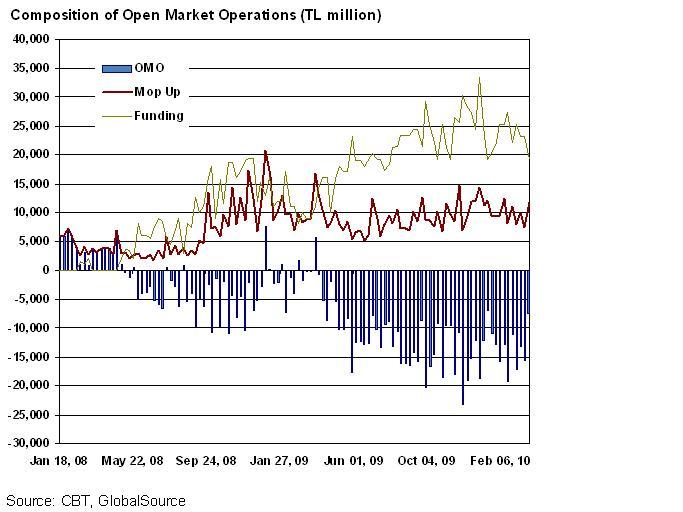
But while I am at it, I wanted to illustrate what I mean by saying all banks are equal, but some are more equal than others. As always, a picture is worth more than a hundred words:

Int this graph, compliments of Turkey Data Monitor, OMO is a net figure, made up of funding and mop-up.

BTW, I have a message to my readers at the Central Bank: It'd be great if the separate mop-up and funding figures appeared in the Weekly Press Bulletin; it is kind of a hassle to get this data from the Central Bank database (EVDS). If CBT's exit strategies go as planned, the data will not ne relevant in a few months, but until then...

Tuesday, April 13, 2010

My own 15 min. of fame

I finally get my Andy Warhol style 15 min. of fame: I will be doing a short phone interview to CemTV (Digiturk Channel 47) at 16.45 Turkish time on today's MPC meeting and the tomorrow's disclosure of the CBT's exit measures. Incidentally, this is what I wrote about in yesterday's Hurriyet column: I still have not been able to post it in the blog -I tried to do it last night, but laptop crashed in the middle of it and I did not have today-, but it is here:

http://www.hurriyetdailynews.com/n.php?n=ignorance-is-strength-2010-04-11

I was hoping to do a live show so that I could get to meet some hot TV chicks, but understandably, the presenter did not want to scare the viewers away (yes, I am that hideous, especially with my eagle tattoo)...

Anyway, the interview will be in Turkish, and I will try to post it here if I can. I'll also post the Hurriyet column later tonight.
Sent by BlackBerry Internet Service from Turkcell

Monday, April 12, 2010

Weekly Hurriyet Column: Ignorance is strength

Below is the unedited version of my column for this week. You can read the final version at the Daily News website, but since I have been editing my columns myself on the Daily News website since March, you won't see much of a difference between the two. As for cheesy references, I am continuing with the seventh art with silver screen adaptations of George Orwell's two most famous works.

As for the column itself, I will illustrate what I mean by saying all banks are equal, but some are more equal than others when I post the Roubini Global Economics version of the column.


One of the maxims of Oceania, George Orwell’s fictional super-state in 1984, is ignorance is strength. That definitely seems to be true for analyzing the Turkish economy.

For example, it is often assumed that there is a one-to-one relationship between inflation, the output gap, which is simply how far away the economy is from potential output, and Central Bank, or CBT, policy rates. As a result, a stronger-than-expected growth outturn, like the GDP readings from the last quarter of 2009 released at the end of March, can cause some to pencil out their inflation and policy rate forecasts for higher numbers.

There are many problems with that hastiness. For one thing, it is the composition of growth that matters, and on that front, as I discussed last week, the data simply do not point to a robust recovery. It also does not make much sense to base one’s forecast on lagging statistics. You could argue that more recent figures such as Industrial Production and Purchasing Managers Index look quite strong, but these volatile indices paint a mixed picture at best after making the necessary seasonal or working day adjustments.

At a more basic level, assuming a direct relationship between the output gap and inflation comes down to assuming that inflation is mainly a demand-pull phenomenon. But inflation is also influenced by cost-push factors such as energy prices and the exchange rate as well as expectations, and these do not warrant a rate hike for now- and I am not even going to get into monetarism. I do think the CBT will have to start raising rates earlier than market expectations of the third quarter; it is just that we are not there yet, so Tuesday’s Monetary Policy Meeting should bring in more cautionary tone but no rate hike.

Similarly, liquidity and interest rate policy are often confused. That’s why the Central Bank’s announcement that it would disclose its exit strategy on Wednesday caused a big stir. Rather than an uncalled-for rate hike, the Bank is likely to disclose the timetable for pulling back some of the liquidity measures it had enacted through the crisis.

Most of the measures were actually for foreign currency liquidity; annulling those measures would do more harm than good at this point. Of the two lira-based measures, the 1 percent decrease in the reserve requirement was a quantity measure, which provided more than 3 billion Turkish Liras of liquidity, whereas the three-month repo auctions were more of a price one, as lengthening the maturity of repos brought down banks’ costs.

Both could be scrapped soon, but more importantly, with the CBT providing liquidity of around 20 billion liras through open market operations for some time now, it seems that liquidity shortage has become a structural phenomenon, exactly of the sort that would induce the Bank to alter its liquidity framework, as outlined in its Monetary and Exchange Rate Policy for 2010.

Moreover, a look at the composition of open market operations reveals that all banks are equal, but some are more equal than others: Open market operations is a net figure, including Central Bank mopping up liquidity as well as funding it, and the Bank has been draining around 10 billions. In other words, some banks have been preferring to lend to the CBT rather than to their compatriots.

Canceling the three-month repos would induce banks to lend to each other to some degree. But the much-talked about technical rate cut would be a huge help, as the Central Bank’s borrowing rates would be set at least a full percentage point below the one-week repo rate, which would be the new policy rate.

Big Brother was right: As much as a little knowledge is worse than no knowledge, ignorance is strength.

Emre Deliveli is a freelance consultant and columnist for Hurriyet Daily News & Economic Review and Forbes as well as a contributor to Roubini Global Economics. Read his economics blog at http://emredeliveli.blogspot.com.

Sunday, April 11, 2010

EconNews Roundup

February Industrial Production comes out higher than expected: But I maintain my stance that signs on the speed of recovery are mixed and high growth this year can not be taken for granted.

Having said that, I should also warn you that there are many who disagree with me. But let me be clear: The March Industrial Production and 1st quarter GDP will come out high on year on year basis because of a base effect- the economy contracted 14.5% yoy in 1Q09!

Rising steel prices worry carmakers: I'll admit, I have a pet project of doing sectoral leading indicators for autos and a few other sectors involving TAYSAD and other associations, so including this news serves as a self-reminder.

I don't want to blame the Daily News too much, as they made the same mistake (as all the other 666 media outlets) of ignoring the most vital part of Econ. tsar Babacan's Haberturk interview: That municipalities will be part of the fiscal rule as well. That addresses one of my key criticisms to the fiscal rule, but Babacan did not confirm that the famous formula will involve consolidated government deficit, not just the central government. But even then, I have some other doubts on the fiscal rule, such as whether the coefficients in the formula are conservative enough, or whether this is the right rule for Turkey (I would prefer an expenditures cap). Then, I have some serious doubt on the implementation as well. Contrary to what many think, this is not Turkey's first attempt at a fiscal rule: You could think of the ill-fated borrowing limits in the fiscal control law, which were being cropped or even nullified with subsequent laws, as a fiscal rule. So the same fate awaits the NEW fiscal rule unless it is hammered into the constitution and credibilized (I know there is no such word) with an independent and authoritative fiscal monitor or budget council. Anyway, you can see a sum-up of my thoughts and writings on the fiscal rule in a recent blog post. By the way, David always likes to humble himself as an ignorant agricultural reporter, but I thought the Daily News editorial on the fiscal rule was quite good.

TSKB REIT comes to ISE: Again, a personal post, as I used to go there a lot when I was a little kid, when my mom used to work there. They had to keep my away from the computers (mind you, this is late 70s, so the computer I am talking about is about the size of a room) by saying that they would snap my fingers, so I used to call them the finger-snapping machines. Leaving this personal anecdote aside, the growth of REITs in Turkey is a interesting development that needs to be followed up.